
by Tiffany LaTrice
Collective care, a central principle in Sonya’s work, invites us to recognize our interconnectedness and commit to creating spaces where all bodies are celebrated and respected. Through storytelling and activism, she demonstrates how practicing empathy, compassion, and solidarity can dismantle systems of oppression and foster inclusive communities by moving from an individualistic mindset to communal practices.
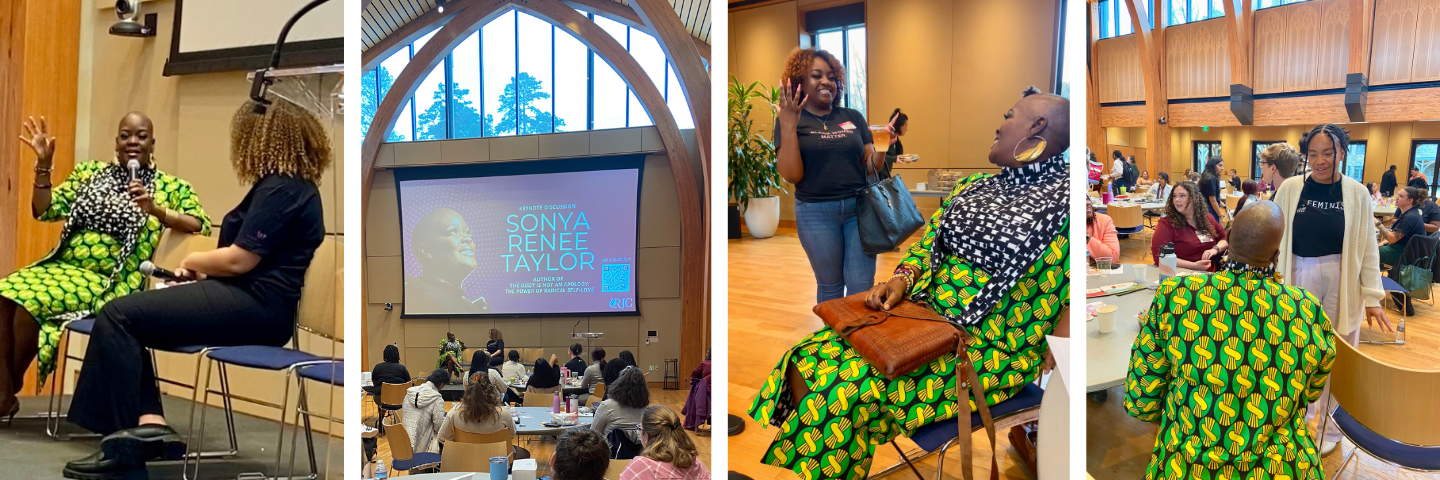
On March 6, I had the opportunity to attend Duke University’s Reproductive Justice Conference where one of Peace is Loud Speakers Bureau members, Sonya Renee Taylor, served as the keynote. The conference was produced by Duke’s Women’s Center and gathered Black maternal health advocates, scholars, students, professors and local state officials to discuss the ways to care for black and brown bodies who are disproportionately affected by malpractice in the healthcare system and uplift organizations, legislators, scholars and activists who are working to change it.
Sonya called us in and asked the audience, “How do you confront the stories you tell yourself that are a part of systems of oppression?” When reflecting on this question, I realize that I’ve moved through life thinking I deserve or will receive less. Sonya challenged me at that moment to rewrite my personal narrative of “less than” to “more than enough.” By operating from a place of abundance, channels and pathways to collective care tend to become present. Because patriarchy has deprioritized Black maternal health, it doesn’t mean we have to and can practice collective care to undermine systemic oppression and racism. I believe that such liberatory practices live within the pages of Sonya’s transformative book, The Body is Not An Apology.
Sonya’s work is a call to action to empower us to reclaim our voice and our bodies as a way to lead us to collective action. She lays the foundation that when we nurture ourselves our collective care for others expands. A simple yet profound framework that centers how community support and solidarity can foster resilience and powerful communities. This principle is particularly relevant in the context of Black maternal health and, where community-based initiatives play a crucial role in providing support and resources for expectant mothers, filling gaps of care in the mainstream American medical system.
“All oppression happens on the body. The lived experience of it is a physical experience. And it’s also the one thing that we all share. So what would happen if we actually made peace with the body? What might that make possible in terms of building a world whose foundation is love?” -Sonya Renee Taylor
But why should we use Sonya’s book as a tool for practicing collective care? The Body is Not An Apology offers not just a blueprint for individual empowerment, but a framework for collective action and systemic change. Sonya challenges us to confront the root causes of injustice and envision a future where everyone receives the care and support they deserve.
Duke University student Maite McPherson moderated the conversation, and said:
“One thing that I am taking away from this is when Sonya had that moment where she said that if you are really enacting radical self-love then you are getting rid of the idea of the “other.” This means that you won’t allow something to happen to another person if you wouldn’t allow it to happen to yourself. By inserting love in all of your relationships, you can use “the body is not an apology” as a framework of resistance.”