
In this behind-the-scenes conversation, Peace is Loud’s Stephanie Palumbo and Florencia Varela discuss piloting a first-of-its-kind Post/Impact Residency with UFO centering care, imagination, and strategy in the documentary post-production process.

Peace is Loud: What inspired the creation of the Post/Impact Residency, and why was now the right time to launch it?

Florencia Varela: The origin of the program was a serendipitous function of having collaborated with Untitled Filmmaker Org (UFO) before, UFO having the infrastructure for a residency program in place, and Peace is Loud being invested in building innovative impact learning spaces for filmmakers. The specific launch date of the program was very much tied to the availability of the venue, which helped catalyze the program’s planning.

Peace is Loud: How did the collaboration with UFO evolve, and what made them the right partner?

Florencia Varela: UFO has been a partner of Peace is Loud for over a year and a half now, through our Collective Lens program. When they approached us with the idea to build a residency, they offered us the opportunity to be imaginative together and ask what it could mean to create protected space for impact planning. UFO brought immense value, from their previous experience delivering film residencies and access to a venue, to their commitment to a more equitable film ecosystem. When we learned about Wood Street, a film about an unhoused community trying to protect each other from eviction, and met with filmmakers Caron Creighton and Estevan Padilla, it ticked all the boxes.
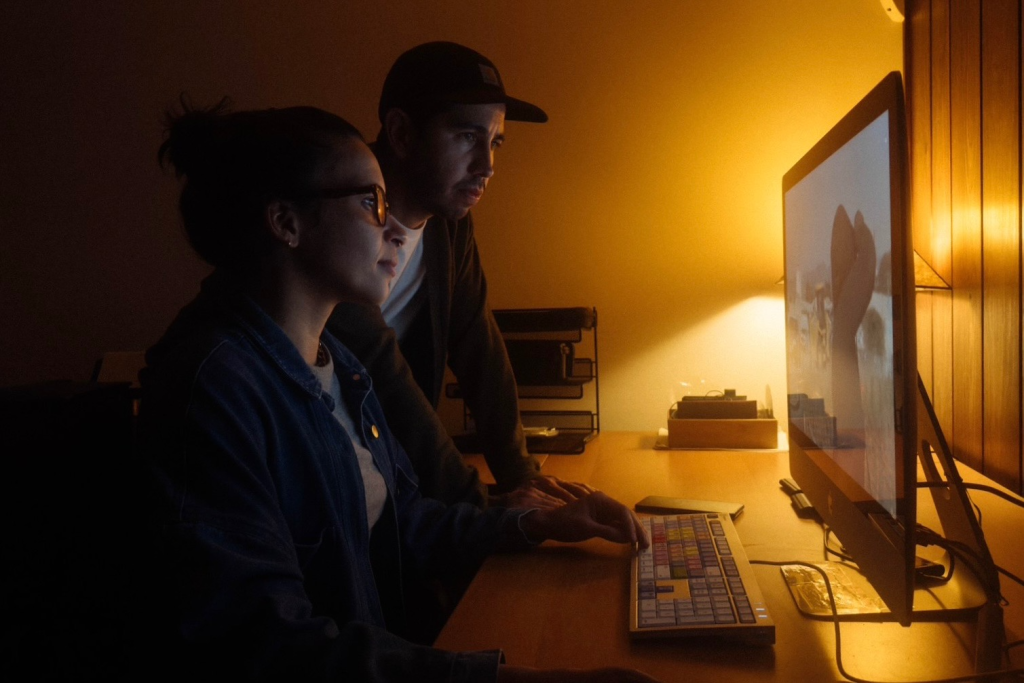
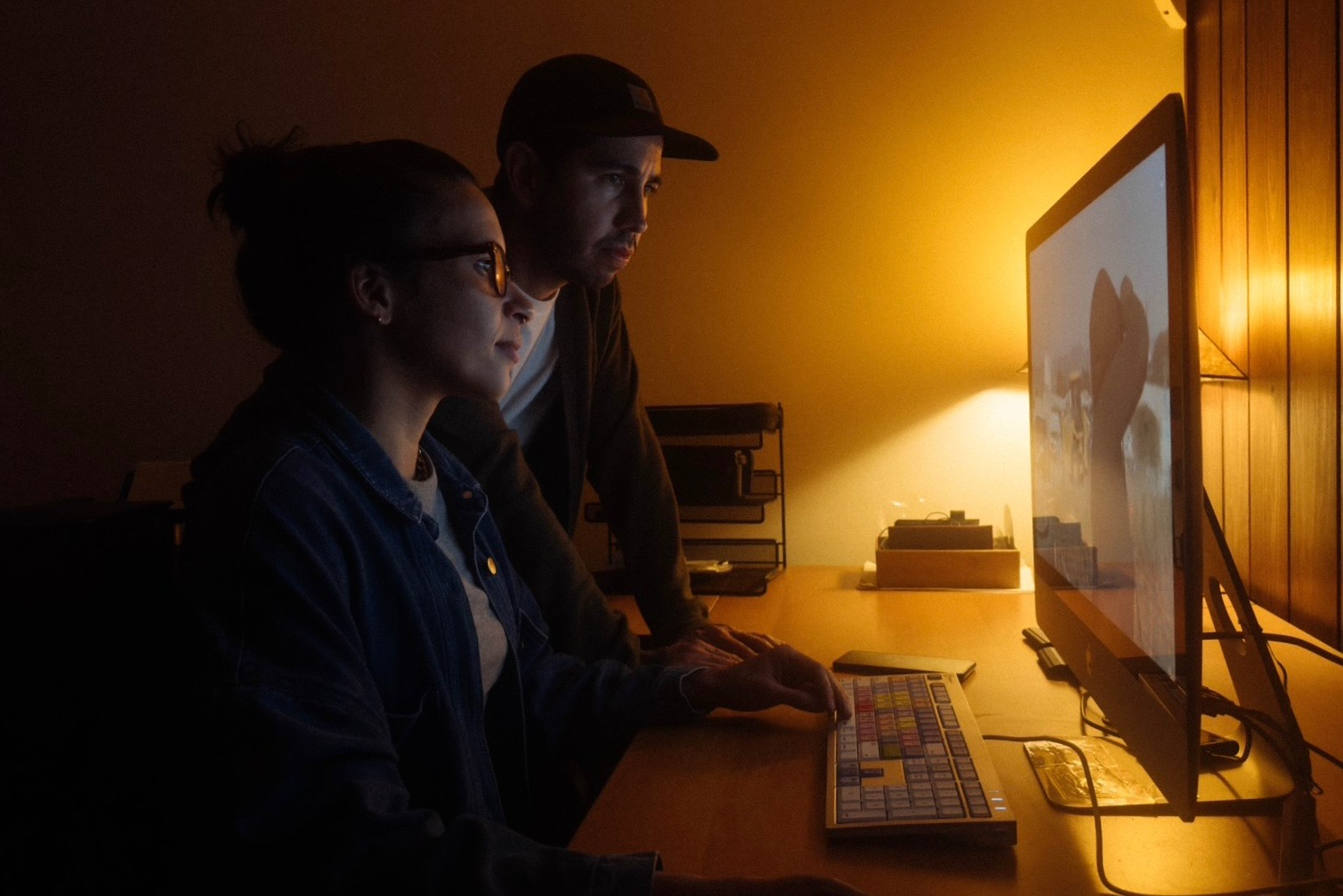
Filmmakers Estevan Padilla and Caron Creighton sit in front of a computer reviewing footage.
Filmmakers Estevan Padilla and Caron Creighton review film footage at the Peace is Loud x UFO Post/Impact Residency

Peace is Loud: Say more about the boxes Wood Street ticked. Why was this an ideal film for the impact residency?

Stephanie Palumbo: We really believe in the power of Wood Street, especially in this moment when encampment sweeps are threatening unhoused communities. This film is perfectly poised to be a catalyst for change and we felt strongly about its artistic merit and also the values and vision of the filmmakers.

Peace is Loud: What sets this residency apart from other film residencies?

Stephanie Palumbo: To our knowledge, there’s no other in-person documentary residency program where filmmakers get dedicated time, space, and strategic support specifically around impact work. Often filmmakers think of impact as a discrete, time-limited campaign, but we see it as ongoing and holistic work. Our residency allows impact to become a crucial part of the creative process.

Florencia Varela: This residency is the first of its kind that we know of. While many residencies are dedicated to films in development, and some impact programs exist virtually, we offered protected time and space to work on both the film and the impact strategy. The fact that we included financial, unrestricted support was also key. Fundraising for participant care work can be particularly difficult.

“Often filmmakers think of impact as a discrete, time-limited campaign, but we see it as ongoing and holistic work. Our residency allows impact to become a crucial part of the creative process.”

Peace is Loud: How did the residency integrate post-production and impact work?

Stephanie Palumbo: Our partners at UFO provided a house with an editing suite for a month. We also brought in an editorial consultant, Rabab Haj Yahya, to view their cut and work with them in person. Flo and I met with the filmmakers to offer our Collective Lens impact frameworks, ask strategic questions, and identify impact and participant care next steps based on the deep knowledge and values Caron and Estevan shared. We also created impact principles and wrote fundraising materials by echoing back their own reflections. Everything is a draft that they can further edit and customize, but we hope it helps minimize the time and labor they’d otherwise spend on this while still finishing their film.

Florencia Varela: The core of the impact work was to create space for reflection and intentional questions around vision and care. Caron and Estevan were able to advance Wood Street from assembly to a rough cut, which is an immense achievement, using their impact principles as a decision-making lens in the edit. We were so energized by how much they shared with us.

Peace is Loud: How did you center care throughout the residency?

Stephanie Palumbo: We let the process be largely informed by the filmmakers’ needs, everything from deliverables to meeting schedules was determined through conversations with them. It was adaptable and responsive.Florencia Varela: An important aspect was financial accessibility. In addition to providing a $10,000 unrestricted grant, we made sure the program included stipends to help offset income or work disruptions, and we covered travel.
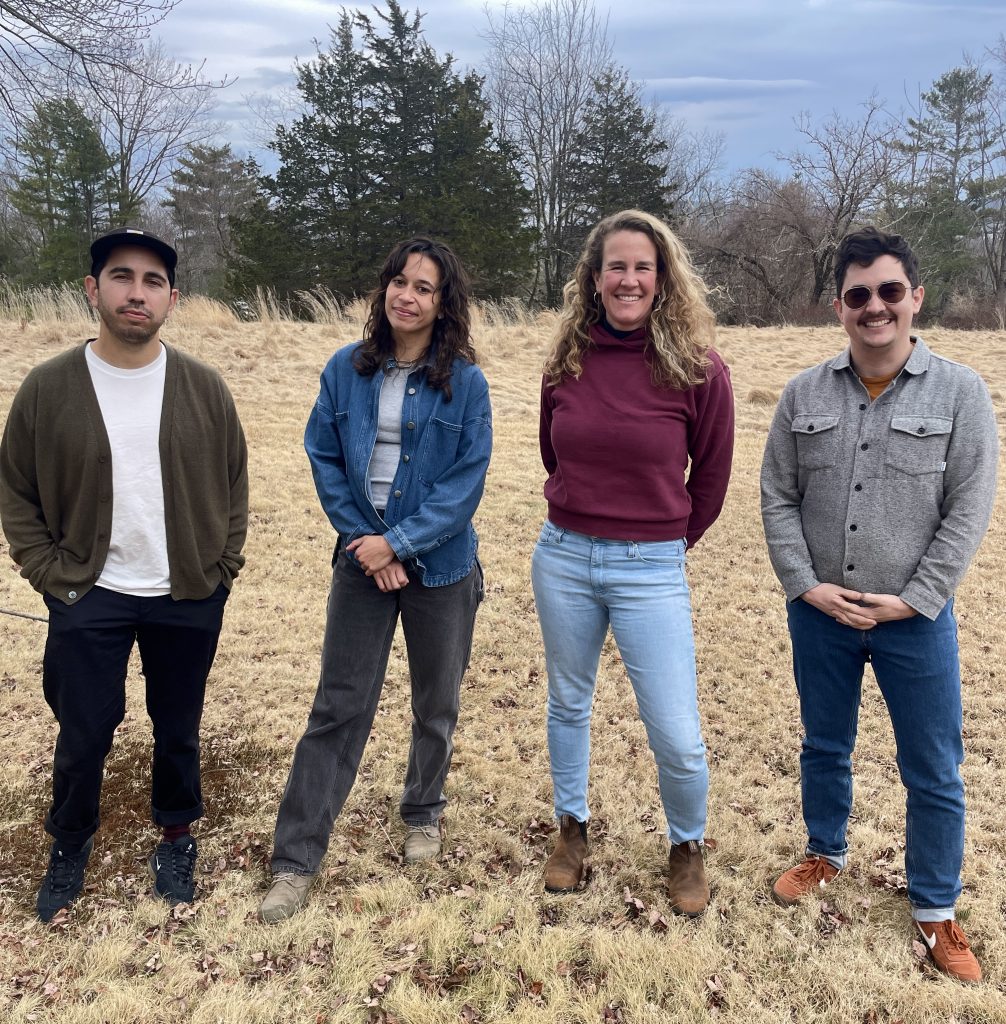
The film team stand in a row facing the camera with blue-gray sky and trees in the background.
From Left: Estevan Padilla (filmmaker), Caron Creighton (filmmaker), Martha Gregory (UFO), Arno Mokros (UFO)

Peace is Loud: What specific needs did the residency seek to address?

Florencia Varela: Everything was rooted in Caron and Estevan’s vision and values. They advanced their project significantly, and it was exciting to be thought partners for the work.

Peace is Loud: What did you learn from this pilot that surprised or moved you?

Florencia Varela: A learning that I always love is that taking measured risks can be very rewarding. We are so grateful that this was an experiment we could embark on with UFO. Spending that much time in a learning space with a film team gave the program a depth that felt very right.

Stephanie Palumbo: I was very moved by the responses from applicants who expressed gratitude for this type of model. It makes me wonder how more organizations could provide deeper impact support like this. 

Peace is Loud: Looking ahead, how do you see this residency evolving?

Florencia Varela: Given our experience with the pilot, I hope we can continue growing innovative learning spaces like the Post/Impact Residency, and keep building expansive (and financial!) support for values-aligned filmmakers. Ultimately, we want to help shift the industry so that impact and care are never afterthoughts.
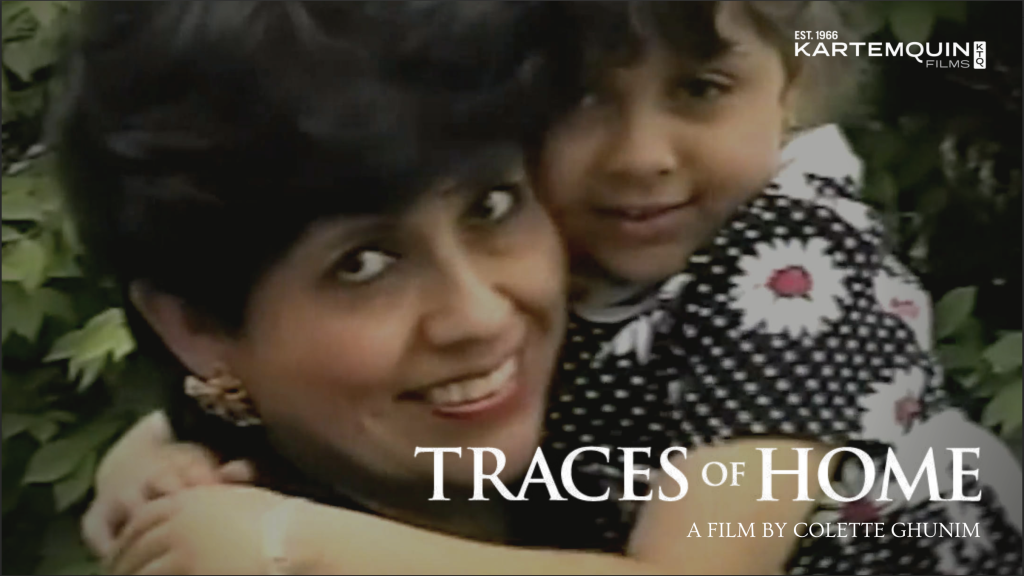
Filmmaker Colette Ghunim reflects on the personal and political journey behind Traces of Home—and how Peace is Loud’s pro-bono office hours for Palestinian filmmakers offered the care, connections, and strategic support to help bring her story to life.

When filmmaker Colette Ghunim began working on Traces of Home, she set out to document her parent’s journey back to their respective homelands in Mexico and Palestine—places they were forced to flee as children. What began as a film about migration quickly deepened into something more intimate and transformative.

“It became not just about this disconnect to home and feeling the disconnect to my roots,” Colette shares, “but it was the disconnect to my parents themselves and learning how to get past [those emotional walls], both within myself, but then with my family.”

That evolving sense of purpose, healing, not just storytelling, is what drew Colette to Peace is Loud’s office hours program for Palestinian filmmakers. Through intentional one-on-one consultations and strategy sessions, the program connects filmmakers with industry partners, impact strategists, and resources aligned with their vision and values.

An aged photo of filmmaker Colette Ghunim hugging her mother as a child.

“As a Palestinian filmmaker, I felt like they were very, very intentional with who they were connecting me to,” she explains. “Through the office hour sessions, I was connected to PBS POV, Arab Film and Media Institute, and a lot of different Arab connections that were super essential for both the fundraising and distribution strategy.”

That care-centered support proved pivotal. Colette credits Peace is Loud’s consultation with helping her apply for, and receive, Working Films Impact Kickstart grant, which will fuel her campaign to bring Traces of Home to communities across the country.

The film is now in its final stretch, with post-production nearly complete and a robust impact campaign taking shape. Colette hopes Traces of Home will serve as both a tool for collective healing and a call to action, connecting the intergenerational trauma of displacement to the urgent fights against border violence and the genocide in Gaza.

“We are very open to any kinds of screening ideas all over the country,” she says. “We hope this film becomes a mobilization tool to end the genocide in Gaza and the occupation.”

Supporters can contribute by funding the final stages of the film and collaborating on its national screening campaign. Because behind every independent film like Traces of Home is a story, and a storyteller, who deserves care, community, and a platform.

To learn more about Traces of Home or to support with a tax-deductible donation please visit the film’s website.

Read about how On The Divide filmmakers partnered with Peace is Loud to amplify voices in the fight for reproductive rights. In this blog, they share their journey, the surprising wins of their impact campaign, and how Peace is Loud continues to shape their approach to filmmaking and social change.

by Peace is Loud

Can you share the story of how you first became involved with Peace is Loud and how the relationship has evolved throughout the years? How has your filmmaking approach changed or been influenced by those experiences? 

Maya and Leah: We connected with Peace is Loud through a relationship formed during Maya’s previous film project. Maya met Florencia at a panel, “This Film Kills Fascism,” hosted by Peace is Loud and The Future of Film is Female. After sharing about On The Divide, we heard positive experiences from other filmmakers and knew Peace is Loud could help us achieve our impact goals.

Making On The Divide was a seven-year journey, documenting the impact of anti-choice legislation on the Rio Grande Valley community. From the start, we wanted to highlight the stories of local organizers, often misrepresented in mainstream media. Telling these stories during a time of increased attacks on reproductive healthcare was challenging, but building relationships with organizations doing critical work made our transition into an impact campaign seamless. We trusted Peace is Loud to guide us in using the film to support on-the-ground efforts.

After working with Peace is Loud, we’ve begun new feature projects, considering impact from the start. We’re building relationships with aligned organizations to reach our target audiences and implementing care protocols for our protagonists—compensation, mental health, and legal support—just as we did with Peace is Loud’s guidance.

What was a win or a high point of the impact campaign that was surprising or unexpected? 

Maya and Leah: It’s hard to fully measure impact given the many ways that people are influenced and touched. However, there was a scenario when one of our partners, Trust Women based in Kansas, used the film as a tool for an upcoming state election that would codify Roe v Wade into state law. They ended up winning the election and Trust Women credited using the film as a political tool for the success.  Knowing that the film was part of this positive outcome was very meaningful especially given the fall of Roe v. Wade just months prior. Also, especially after working on a project for so long it was so amazing to see how energized student groups were who watched the film.  There was something special about seeing a spark in someone who otherwise was unfamiliar with the topic now after watching the film was called to action to support the many organizations that we worked with on our campaign. 

How did the passing of SB8 in Texas and the SCOTUS decision overturning Roe v. Wade during the On the Divide impact campaign affect your approach to care and support for the film participants?

Maya and Leah: When SB8 passed and Roe was overturned, we shifted our focus to helping our participants and supporting local organizations like South Texans for Reproductive Justice. We asked our partners and participants what they needed most at that moment. With Peace is Loud’s help, we raised over $20,000 for reproductive justice groups and distributed funds directly to our participants. The Valley had been in a post-Roe reality for years, and we knew grassroots organizations were having the greatest impact. So, we focused our campaign on supporting these groups directly.

What was your experience of sharing the On the Divide case study with other filmmakers in Collective Lens?

Maya and Leah: It was really amazing to be able to share our case study for On The Divide because it allowed us to reflect on what we were able to accomplish, what we learned throughout the process, and what we would’ve done differently. It was also great to be in a space with both filmmakers and those involved with reproductive rights because we were able to share knowledge and resources with each other.  Sharing  the impact journey for On The Divide was eye opening. It allowed us to look back on what our goals were when we started and what the impact campaign became.  It was also great to see what we could do for future impact campaigns. 

How did being part of the rePRO Collective Lens cohort group build on your past experiences with Peace is Loud?

Maya and Leah: When we worked on On the Divide, we didn’t connect with many filmmakers focused on reproductive rights. Being part of the rePRO Collective Lens cohort gave us that community. Peace is Loud joined our project during a volatile time, and the cohort gave us space to reflect and develop more effective impact strategies. It highlighted the importance of community-building from the early stages of production. The cohort reminded us that storytelling is essential for social change, helping connect grassroots work and personal narratives with larger audiences.

Learn more about RePROFilm and Collective Lens: A Community Impact Space here. It’s an impact training program for a community of filmmakers committed to reproductive health and justice, equipping creators with community, and values-forward tools and strategies to position their films in solidarity of the reproductive health and justice movements.

Campaign Information

The Standing Above the Clouds impact campaign will mobilize the film as a tool for strengthening and building the power of kia’i (protectors) within the movement to protect Mauna Kea and beyond. The specific strategies that guide our campaign will be determined in close collaboration with Standing Above the Clouds’ all-women film team and protagonists, who are organizers from Mauna Kea Education and Awareness (MKEA).

Film Information

Standing Above the Clouds is a powerful feature documentary about the Indigenous women behind the largest social movement in modern Hawaiian history. The film follows three Native Hawaiian families who dedicate their lives to defending the sacred mountain Mauna Kea from the building of the world’s largest telescope, which threatens the island’s water table and cultural practices. Through the lens of mothers and daughters, Standing Above the Clouds explores the social and emotional labor of retaining ancient ceremonies in a rapidly modernizing world.

  • Director: Jalena Keane-Lee
  • Producers: Amber Espinosa-Jones, Erin Lau
  • Editor: Diana Diroy
  • Executive Producers: Anya Rous, Jess Devaney
  • Consulting Producer: Ciara Lacy


Support Our Partner

Mauna Kea Education and Awareness (MKEA)

MKEA’s mission is to educate and raise the awareness of communities in Hawai’i and beyond on the spiritual, historical, cultural, environmental, and political significance of Mauna Kea and provide cultural learning opportunities to everyone from keiki to kupuna, residents, visitors, and others concerned about native and cultural rights and responsibilities in order to create a platform for the protection of sacred places and for social justice and positive change. 

Watch a Clip

After over two dozen kupuna (elders) are arrested protecting Mauna Kea, a group of mana wahine (fierce women) line up and link their arms together in front of them to stop the arrests. Chanting and singing together, they successfully stop the arrests and force the police to turn back.

This campaign ran from May 2022–March 2023.

The campaign for The Ants and the Grasshopper used the film as a tool to grow the power of the climate justice movement. We used the example of protagonist Anita Chitaya to move progressive Christian communities to become climate activists. The campaign encouraged them to shift from thinking as individuals to embracing long-term, collective solutions, following the lead of those on the frontlines of the climate crisis. Our multi-pronged approach included using targeted screenings, resource creation, and digital outreach to promote the film amongst Christians, and in doing so was successful in activating those communities to join the climate justice movement.

Services Provided

  • Campaign design
  • Strategic partnerships
  • Original resource creation
  • Grassroots screenings
  • Digital ad targeting

Our Partner

  • The HEAL Food Alliance was born out of the knowledge that no single individual, organization, or sector can transform systems in isolation. We believe that true transformation requires diverse skills, roles, and resources— and, it requires organizing together for real change. We have partnered with HEAL Food Alliance to craft action items that direct audiences to collective actions led by BIPOC grassroots organizations.


Film Credits
  • Directed by Raj Patel and Zak Piper
  • Narrated by Anita Chitaya and Peter Mazunda


Watch the Trailer

Case Study

In 2022 and 2023, Peace is Loud helped the Fire Through Dry Grass creators strengthen their collaborative practices and build the foundation for a care-centered impact campaign.

This case study examines their filmmaking process and provides learnings and resources for other filmmakers.

Services Provided

  • Mentorship of the film’s Co-Producer/Associate Impact Producer
  • Securing mental health support as needed
  • Developing a plan for compensation and profit-sharing with the team
  • Writing a case study with learnings about this collaborative filmmaking process

Get Involved

Sign on to the Reality Poets’ Nursing Home Lives Matter Bill of Rights


Film Credits

  • Co-Directed by Alexis Neophytides and Andres “Jay” Molina
  • Produced by Jennilie Brewster and Alexis Neophytides


Watch the Trailer