
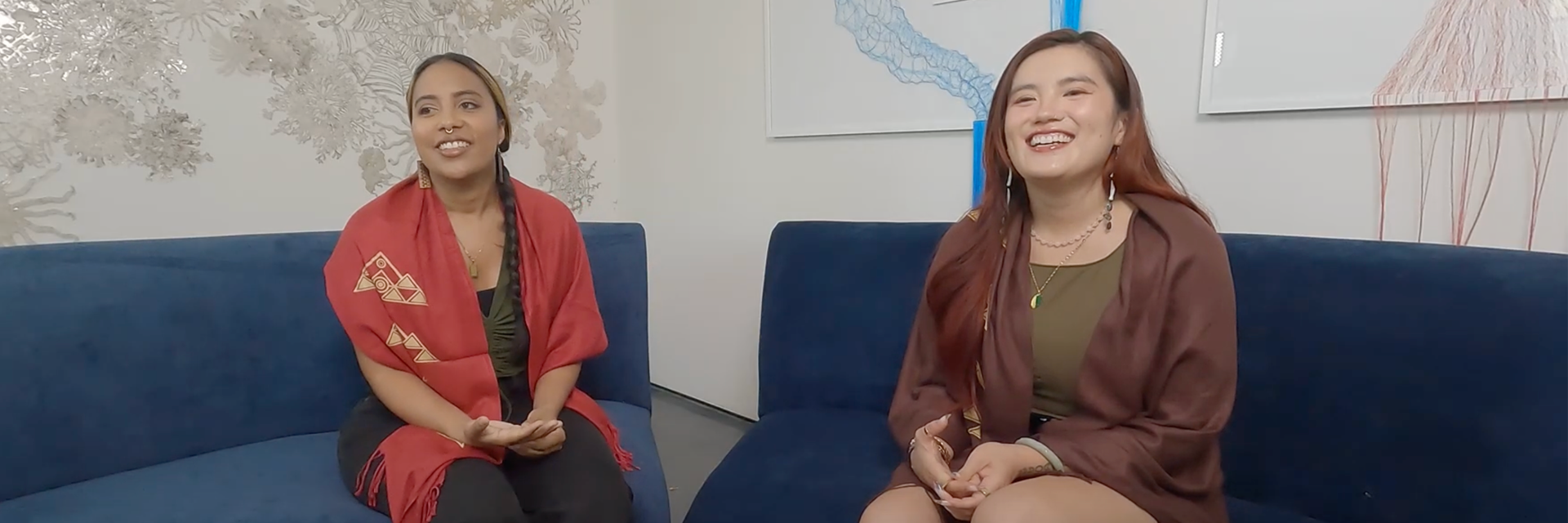
with Amber Espinosa-Jones and Jalena Keane-Lee
by Danielle Feder
—
Because documentary filmmaking has historically relied on extraction and exploitation, it’s exhilarating to witness a new wave of filmmakers reject harmful norms in favor of prioritizing ethics and care. We sat down with Amber Espinosa-Jones and Jalena Keane-Lee, the producer and director behind the film for our current impact campaign, Standing Above the Clouds, to discuss how they intentionally built care and healing into their filmmaking process. They shared some challenges they faced, how they have cared for themselves alongside the film participants, and more!
Here is an excerpt from that conversation:
Peace is Loud: Jalena, you’ve talked about reimagining the documentary form as a healing process. What did that look like while making this film, from filming to post-production?
Jalena: It’s really important to me to recognize the roots of the documentary form as coming from a place of extraction and of colonial mindset, of wanting to take the most and give the least. Of coming into communities and documenting, coming to your own conclusions about what was going on, and then making money off of it. I really wanted for this project to be something that could give agency to the only people that it makes sense to tell this story.
The kia’i (protectors) and the mana wāhine (powerful women) behind it are on the front lines and are being so vulnerable in sharing intimate details about their lives and the things that they’re going through. And as Hāwane said in the film, through the journey of protecting a sacred place, you also learn how to protect and care for yourself. There can be so much fire in young people, and having the advice and the wisdom of elders is so helpful for healing through trauma and also being able to be present on the front line.
We see ourselves as part of a new wave in documentary of wanting to make stories intentionally this way, so from the very beginning, it was a very collaborative project. I wanted to make sure that Aunty Pua and anyone else who wanted to get involved felt like they could. We had a collaborative edit process where we would share edits before it was finalized and then get feedback. It was really nice to be able to have a discussion and a dialogue about what [a particular moment] means and how they want to be represented, and the story that we want to tell and what we’re seeing through it too.
Peace is Loud: What were some of the biggest challenges you faced throughout production?
Jalena: We know how amazing [Pua, Hāwane, and Kapulei] are, how funny they are, just the full depth of their personality. But there’s no film, there’s no 1.5 hour thing that can ever show someone fully. This is just an exploration of a certain side of them during a certain time in their life, and [we had to] accept that we’re not going to be able to show everything or explore every element of who someone is.
Amber: We’re going through our lives in the same way the women in the film are going through their lives. So, protecting yourself so you can still do the work and balancing the inequities of the filmmaking ecosystem in itself [was a challenge]. Meanwhile, [you’re] holding all the truths of what you’re experiencing as a human being at the same time. And then, coming at it as an all women of color team working on their first feature, people don’t trust you or they don’t want to take a risk, and having to fight a lot of that and not get discouraged was also a challenge.
Jalena: That was a really big one, the mental and emotional strength that it took to complete the film and to do the industry side stuff. I think the secondary trauma of hearing from people about their experiences on the frontline or witnessing hard experiences, that’s really challenging and difficult. And then, having to bridge that into a funder space and figure out how to package it and give off confidence that it’s going to be a big hit. In reality, we don’t know how things are going to turn out, but that doesn’t mean we shouldn’t be trusted with enough funds to make the film.
Peace is Loud: How have you balanced sharing the film with audiences while also prioritizing care and rest for yourselves and the rest of the team?
Jalena: Well, an important lesson that we see from the film is that for our generation, part of our responsibility is to care for ourselves and to also teach our mothers and our aunties and that generation through example how to take better care of themselves. So it’s something that we try to model as much as we can. We try to be mindful because I think a lot of people that are involved in activism, like a lot of filmmakers, are used to pushing ourselves to the edge and not really valuing ourselves as human beings that have needs. Even though we live in a system that tries to strip us of our humanity, we try to return it to each other, even through simple things like checking in and trying to have days that are planned with breaks and meals.
Amber: And outside of that, when we’re sharing with audiences, we’re super concerned with how people are reacting. What is it like for the people in the film to watch the film again? What is it like for us to watch the film again? What is it going to bring up? And how do we protect that space afterwards and before, and what resources do we need that we’re going to develop?
Peace is Loud: What do you hope audiences take away from watching Standing Above the Clouds?
Jalena: We hope when people watch Standing Above the Clouds, they feel inspired to stand for their community and the things that are sacred in their community. And that they know that sisterhood is such a gift and that being involved in movements shapes us and changes us in such beautiful ways.
Amber: We’re also really interested in [sharing] this new movement for ethical filmmaking and changing the way that documentary filmmaking has been done in the past, to make sure there’s consent and there’s ethics and ongoing trust.
—
Get involved with the Standing Above the Clouds impact campaign and the movement to protect Mauna Kea:
- Sign the Change.org petition to stop the construction of the Thirty-Meter Telescope
- Host a screening of the film in your own community
- Donate to Mauna Kea Education and Awareness
- Follow MKEA on Instagram for updates
Peace is Loud has also released a suite of Participant Care resources, available for free to support anyone in the documentary field interested in better prioritizing the health and well-being of their film participants. Learn more and download!